Awa Architecture Overview
Awa (Māori: river) is a Postgres-native background job queue for Rust and Python. Postgres is the sole infrastructure dependency: there is no Redis, RabbitMQ, sidecar scheduler, or separate lease store. Producers enqueue inside ordinary Postgres transactions, workers claim and complete jobs through the same database, and one elected worker runs cluster-wide maintenance.
Awa keeps application data and background work in one transactional system of record. Producers commit jobs with their business writes; workers claim attempts using lease-guarded PostgreSQL transitions; maintenance makes deferred work runnable, rescues abandoned attempts, and reclaims old ring partitions. There is no second broker whose acknowledgement state can diverge from the database transaction.
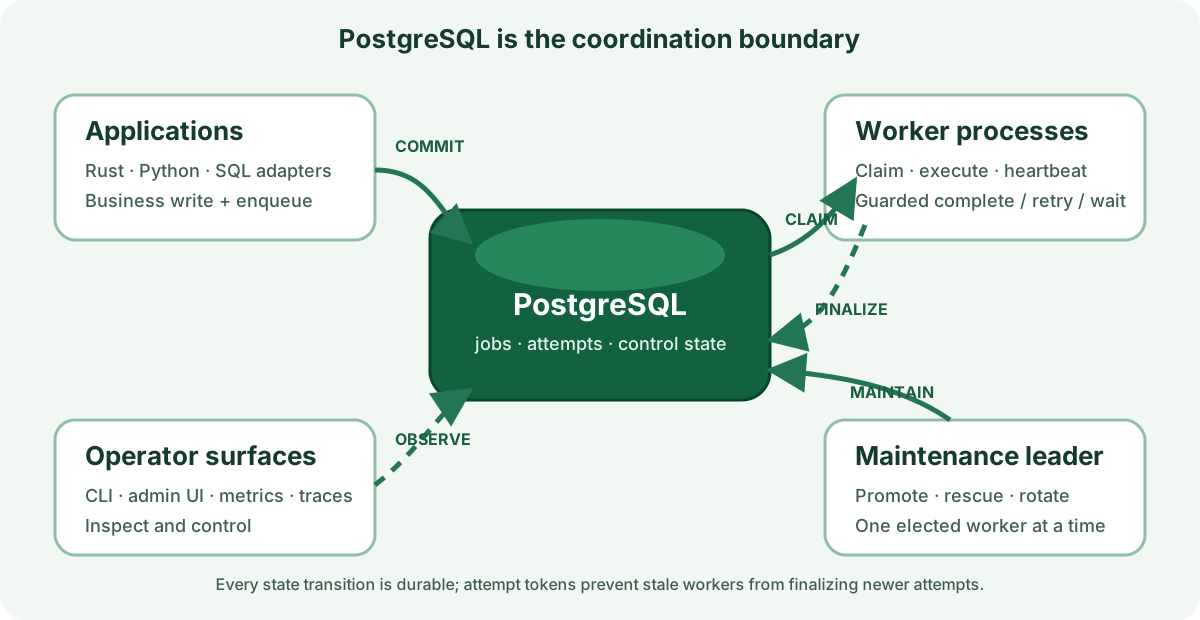
The diagram is the useful boundary: application processes produce work, worker processes execute it, and PostgreSQL is authoritative for both job state and coordination. The admin surface observes and controls that system; it is not part of the dispatch hot path.
For migration details see Migrations. For user-facing knobs see Configuration.
Terms
- A claim is the storage transition that makes a ready job belong to one attempt. It increments
run_lease; later completion, retry, rescue, and cancellation must match that lease number. - A deferred job is not claimable yet. Future
run_atjobs and snoozed jobs arescheduled; retry backoff andRetryAfterrows areretryable. Maintenance promotes due deferred rows into the ready ring. - A lane is one ordered
(queue, priority, enqueue_shard)stream. Raising the shard count creates more lanes for the same logical queue. - A lease is the durable live-attempt row used when an attempt needs mutable execution state such as heartbeat, progress, callbacks, or deadlines.
- A receipt is the lighter claim evidence used for short attempts. A receipt can be a row in
lease_claims_*or an item inside a compactlease_claim_batches_*row. Compact batch claims carry a claim-batch id and one-based item index so completion can validate the exact item without searching the batch by receipt range. Receipt attempts close through durable closure evidence: explicit closure rows for non-success and cold paths, or compact claim-local closure batches for successful hot-path completions. Successful completions also write compact terminal history that is exposed throughterminal_jobs. Open receipts are derived by anti-joining row and batch claims against every closure-evidence family. - A segment is a ring partition. Awa rotates segments and truncates whole old segments instead of vacuuming hot history row by row.
- A ready tombstone is an append-only marker that excludes an immutable ready row from future claims.
Runtime Shape
The runtime is three cooperating layers:
| Layer | Owns | Notes |
|---|---|---|
| Application code | Producer transactions, Rust handlers, Python handlers, optional HTTP worker targets | Enqueue can commit or roll back with the application's own writes. Rust and Python workers share the same storage engine. |
| Worker runtime | Dispatchers, executor tasks, guarded completion, per-process heartbeat refresh, maintenance leader election | Every worker process runs these services. Only one process wins the maintenance lock at a time. |
| Postgres | Queue state, execution state, control metadata, uniqueness, cron rows, runtime snapshots | Postgres is the coordination point for visibility, claim ownership, recovery, callbacks, and operator state. |
The important ownership split is simple: every worker can dispatch and heartbeat its own attempts, but exactly one elected maintenance leader runs cluster-wide promotion, rescue, queue/lease/claim ring rotation and prune, DLQ cleanup, descriptor cleanup, cron evaluation, metadata refresh, and queue-health publication.
While a storage transition is unfinalized, the leader promotes the deferred backlog and runs the rescue sweeps of both planes regardless of which engine it resolved at startup, so a drain cannot stall — and mid-flight jobs cannot wedge — on which runtime happens to hold the lock (#456). The extra passes are no-ops once the cluster is finalized.
Deployment Model
- Awa assumes one shared Postgres database and any number of Rust or Python worker processes.
- Each process registers the queues and job kinds it can execute.
- Queue work is awakened by
LISTEN/NOTIFYwith polling as the fallback. - The maintenance leader is elected inside the same worker fleet; no
pg_cronor external scheduler is required. - Long analytical reads should run on replicas or with disciplined timeouts, because long-lived primary transactions can delay best-effort partition prune.
Storage Planes
Queue storage is the worker engine in 0.6. It is not one mutable jobs heap; it is split into queue, execution, and control planes so each plane carries the right kind of churn.
| Plane | Tables | Shape | Why it matters |
|---|---|---|---|
| Queue | ready_entries_*, ready_claim_attempt_batches_*, ready_tombstones_*, ready_segments_*, done_entries_*, receipt_completion_batches_*, receipt_completion_tombstones_*, queue_terminal_count_deltas_* |
Ring partitions by ready_slot plus compact ready-segment and attempt-emission maps |
Runnable and terminal rows stay append-first; emitted attempts leave compact queue-slot-local batch/range evidence so stale claim cursors do not need to scan claim-ring partitions; rare ready mutations append tombstones instead of deleting ready rows; claim routes through compact ready segments before reading ready rows; successful receipt completions can use compact batch terminal history; done_entries terminal-count changes append signed deltas, compact completions are counted from retained batches, and the whole segment is reclaimed by queue-ring prune. |
| Queue backlog | deferred_jobs |
Plain table | Scheduled and retryable work stays out of the hot claim path until promotion. |
| Operator hold | dlq_entries |
Plain table | DLQ rows are explicit operator backlog with retry, purge, and retention cleanup. |
| Receipt execution | lease_claims_*, lease_claim_batches_*, lease_claim_closures_*, lease_claim_closure_batches_* |
Ring partitions by claim_slot |
Short attempts avoid mutable lease rows. Zero-deadline hot claims can store many receipts in one compact claim-batch row; deadline-backed claims keep row-local claim evidence for indexed deadline rescue. A compact claim can still materialize into a lease if the worker later needs mutable attempt state. Each receipt gets an immutable receipt_id; compact completion validates row-local receipts by tuple identity and compact-batch receipts by returned batch id/index plus receipt id before writing closure batches. Stale-rescue and deadline-rescue scans use the same per-attempt advisory key before closing rescue-eligible receipts. |
| Materialized execution | leases_*, attempt_state |
Lease ring plus mutable state table | Attempts escalate here when they need callback waiting, progress, or other mutable attempt state. |
| Control | queue_lanes, heads, ring-state tables, queue_meta, descriptors, runtimes, cron, uniqueness |
Narrow metadata tables | Claim cursors, queue state, operator metadata, uniqueness, and liveness are kept separate from payload history. |
The asymmetry is intentional. Ready/done, lease, and receipt tables are ring-pruned because they are hot. Deferred and DLQ rows are backlog/hold tables with their own promotion, retry, purge, and retention paths. Control tables stay narrow because they are the coordination surface dispatchers and maintenance touch most often.
Storage Surfaces
Most applications should use the Rust, Python, CLI, or UI APIs rather than querying queue-storage tables directly. The SQL objects still matter for operators, adapters, and incident read-outs, so Awa separates read surfaces from physical transition surfaces:
| Surface | Role | Consumer contract |
|---|---|---|
awa.insert_job() |
Planned public v1 SQL producer capability under #342. It presents one stable request/result/error contract, uses a final opts jsonb DEFAULT '{}'::jsonb extension point, computes ADR-033 concurrency routing authoritatively from logical keys, and delegates to the active storage implementation. |
Public SQL contract once shipped. Prefer configured direct COPY for trusted high-volume producers that accept ADR-043's broader privilege profile. |
awa.jobs / awa.insert_job_compat() |
Canonical compatibility plumbing used during the storage transition and by current Rust/Python adapters. When queue storage is active, the runtime does not claim or complete from awa.jobs; compatibility inserts route into the active backend, and SQL deletes of ready rows append ready tombstones. |
insert_job_compat remains the transitional SQL producer contract listed in docs/stability.md until #342 ships awa.insert_job() and completes its migration/deprecation step. Its storage internals and other _compat helpers remain internal. |
{schema}.terminal_jobs |
Read-only hydrated view over queue-storage terminal history. It joins narrow done_entries_* rows and compact receipt_completion_batches_* rows back to retained ready_entries_* bodies. |
Public read surface for SQL inspection and reporting of terminal queue-storage rows. It is not a write or transition surface. |
ready_entries_* |
Physical runnable queue ring. | Internal storage. Read only for low-level debugging; writes must go through Awa enqueue, claim, retry, cancel, or maintenance paths. |
ready_claim_attempt_batches_* |
Physical attempt-emission ledger keyed by ready slot/generation and lane ranges. | Internal storage. Receipt-mode claim writes one compact batch row in the same transaction as its receipt claims; stale claim-cursor recovery treats committed covered lanes as evidence that those lanes already emitted run_lease + 1. Legacy materialized claims use their exact lease attempt as evidence. Queue prune truncates it with the matching ready segment. |
ready_tombstones_* |
Physical ledger for ready lanes made unavailable by cancellation, priority aging, or similar out-of-band ready mutations. | Internal storage. Claim treats matching rows as spent lane evidence and exact-count paths skip them; maintenance truncates it with the matching ready segment. |
ready_segments_* |
Compact control-plane map from committed ready lane ranges to their ready slot/generation. | Internal storage. Claim uses it to choose the target ready segment before validating ready_entries_*; ranges are split when the lane-head run_at timestamp changes so claim-time priority aging stays exact as the cursor advances; queue prune truncates the matching ready-slot child. |
queue_claim_heads ready-segment columns |
Legacy nullable ready-slot/generation cache beside the per-lane claim cursor. | Unused. claim_ready_runtime resolves the target ready slot from ready_segments_* on every claim instead of caching it here — the per-claim UPDATE of this singleton row was the dominant dead-tuple source under a pinned MVCC horizon. The columns are retained for rolling-upgrade compatibility; dropping them is deferred to a major version. |
done_entries_* |
Physical terminal fact ring for failed, cancelled, non-receipt, and wide terminal rows. Ready-backed rows can intentionally omit duplicated body columns. | Internal storage. Direct readers must tolerate nullable duplicated body fields and must not assume all completed rows are present here; use {schema}.terminal_jobs for hydrated terminal rows. |
receipt_completion_batches_* |
Compact physical terminal history for successful receipt-backed completions. Each row stores one completion batch and expands through {schema}.terminal_jobs. |
Internal storage. Optimized for hot-path append and queue-ring truncate; not a public query surface. Claim-closure proof for these completions lives in claim-slot-local lease_claim_closure_batches_* rows. SQL compatibility delete may scan retained compact batches by job id, but the hot path does not maintain a job_ids index for that cold operation. |
receipt_completion_tombstones_* |
Cold deletion ledger for completed rows synthesized from receipt_completion_batches_*. |
Internal storage. SQL compatibility delete writes here so terminal_jobs can hide a compact completed row without mutating the compact batch. |
queue_terminal_count_deltas_* |
Append-only signed terminal-count ledger for done_entries mutations. done_entries inserts append positive deltas; retry, discard, DLQ move, and compatibility delete of done_entries rows append negative deltas. |
Internal derived storage. Exact count reads include pending deltas plus retained compact completion batches minus compact tombstones; maintenance folds sealed-slot deltas into queue_terminal_live_counts and prune truncates the matching delta segment. |
queue_terminal_live_counts, queue_terminal_rollups |
Folded done_entries counters for retained queue segments and permanent terminal counters for pruned queue segments. |
Internal derived storage. Rebuild live counts from {schema}.done_entries if the trust marker is cleared or after a counter incident; compact completions remain counted from retained batches until prune folds them into rollups. |
deferred_jobs |
Physical scheduled/retryable backlog table. | Internal storage. Promotion, retry, snooze, and cancellation own its transitions. |
dlq_entries |
Durable operator hold table for DLQ-enabled terminal failures. | Operator surface through CLI/UI/API; direct SQL inspection is reasonable, direct mutation is not. |
lease_claims_* / lease_claim_batches_* / lease_claim_closures_* / lease_claim_closure_batches_* |
Receipt-plane execution history for short attempts. | Internal storage. Live receipt attempts are row claims or compact batch items without durable closure evidence. Explicit closures cover non-success and cold paths; compact closure batches cover successful hot-path completions, expose a range-indexed receipt membership proof, and carry ready segment metadata for prune count proofs. Maintenance uses claim_ring_slots rescue cursors to keep stale and deadline scans bounded when closed receipt history cannot yet be truncated. |
leases_* / attempt_state |
Materialized execution state for heartbeat, callbacks, progress, and other mutable attempt data. | Internal storage. Runtime and rescue paths own mutations. |
queue_lanes, queue heads, {ring}_ring_rotations ledgers, {ring}_ring_state config, queue_terminal_rollup_deltas, queue_meta |
Claim cursors, enqueue heads, append-only rotation-ledger cursors (current cursor = max-generation row; ADR-040), ring config, pending prune-rollup deltas, and queue storage configuration. | Internal control surface except documented configuration fields such as queue_meta.enqueue_shards. If no queue_meta row exists for a queue, enqueue defaults to one shard; operators should configure shard counts with an UPSERT before load tests or production traffic. |
| descriptors, runtime snapshots, cron tables | Operator metadata and scheduler declarations. | Public through Awa APIs and UI; SQL reads are acceptable for reporting. Writes should go through the corresponding Awa APIs. |
ADR-019 is the storage-engine source of truth; ADR-023 supersedes it for the receipt plane, and ADR-026 refines terminal history:
- ADR-019: Queue Storage Engine
- ADR-023: Receipt Plane Ring Partitioning
- ADR-026: Narrow Terminal History
For how the per-schema substrate is installed and who owns which objects, see Queue-storage substrate. The default awa.* substrate is materialised by awa migrate; custom queue-storage schemas are installed via the awa.install_queue_storage_substrate() SQL helper that prepare_schema() and awa storage prepare-queue-storage-schema both call into.
Job Lifecycle
Core transitions:
| From | To | Trigger |
|---|---|---|
| insert | available |
Immediate enqueue. |
| insert | scheduled |
Future run_at. |
scheduled / retryable |
available |
Maintenance promotion when run_at <= now(). |
available |
running |
Dispatcher claim; run_lease increments. |
running |
completed |
Handler succeeds. |
running |
retryable |
Handler returns a retryable failure, or RetryAfter. |
running |
scheduled |
Handler snoozes; the attempt is not counted. |
running |
waiting_external |
Handler parks for callback or sequential wait. |
waiting_external |
running |
resume_external resumes a sequential wait. |
running / waiting_external |
cancelled |
Handler cancel, admin cancel, rescue cancellation, or a transition-time re-schedule superseded by a newer unique-claim holder. |
running / waiting_external |
failed |
Attempts exhausted, terminal error, or callback timeout exhaustion. |
failed |
dlq_entries |
Optional per-queue DLQ routing. |
run_lease increments at claim time. Runtime mutations carry (job_id, run_lease), so stale completions, retries, snoozes, cancels, and callback resumes lose after rescue, admin cancellation, or re-claim.
During a storage transition, a canonical re-schedule acquires any unique claim required by its destination state before its queue-storage successor can become executable. If a newer duplicate acquired the key while the running state was outside the job's unique_states mask, the newer job keeps the claim and the old attempt is recorded as cancelled terminal evidence with rescheduled as duplicate.
Terminal rows differ by storage backend:
- In queue storage, terminal history is reclaimed by queue-ring prune. Successful receipt-backed completions normally write compact rows in
receipt_completion_batches_*and compact claim-local closure evidence inlease_claim_closure_batches_*; custom terminal payload snapshots live indone_entries_*so read surfaces preserve per-job metadata. Awa-owned provenance metadata from priority aging or queue/priority moves remains compact-safe. Failed, cancelled, non-receipt, and wide terminal snapshots live indone_entries_*. Ready-backed terminal rows are narrow: immutable job-body fields stay in the retainedready_entries_*row and public/admin reads hydrate through the storage surfaces described above. Unclaimed ready cancellation and priority aging do not delete ready rows; they appendready_tombstones_*rows so claim and exact-count paths skip the old lane until queue prune reclaims the segment.done_entriesterminal-count changes append toqueue_terminal_count_deltas_*; exact count reads include those pending deltas plus retained compact batches minus compact tombstones until maintenance folds sealed slots into compact live counters or prune folds the whole segment into permanent rollups. Receipt claims that materialize intoleasesfor callbacks or mutable attempt state still complete through the lease-deleting path; that path identifies the lease by stable ready-lane and attempt keys because the lease ring may have rotated since the original claim. - DLQ-enabled terminal failures are routed or moved into
dlq_entriesinstead of ordinary terminal history; that table has explicit retention cleanup plus operator retry/purge. - In the canonical compatibility path, terminal rows in
awa.jobs_hotuse row-by-row retention cleanup.
Progress is cleared on successful completion and preserved across retry, snooze, cancel, fail, and rescue. On queue storage, mutable progress snapshots live in attempt_state once an attempt first needs that mutable state; they are not rewrites of the immutable ready row. Cancellation is cooperative for live handlers: Rust handlers can poll ctx.is_cancelled(), Python handlers can poll job.is_cancelled(), and stale storage writes are still rejected by the run_lease guard if a handler misses the signal.
Enqueue And Claim
sequenceDiagram
    autonumber
    participant P as Producer
    participant Q as Queue storage
    participant D as Dispatcher
    participant R as Ring state
    participant E as Executor

    P->>Q: single insert or direct COPY enqueue inside app transaction
    Q->>Q: append ready_entries or deferred_jobs
    Q-->>D: NOTIFY awa:<queue>
    D->>D: pre-acquire local permits
    D->>Q: claim_runtime_batch_with_aging_for_instance
    Q->>Q: lock queue_claim_heads FOR UPDATE SKIP LOCKED
    Q->>R: read lease and claim ring cursors
    Q->>Q: append receipt or materialize lease
    Q-->>D: claimed jobs + run_lease snapshots
    D->>E: execute handlers
Enqueue is transactional: if the producer's outer transaction rolls back, the job never becomes visible. Immediate jobs reserve a lane sequence range under a transaction-scoped lane lock, append to ready_entries_*, and append a compact ready_segments range for the committed lane sequence range; future scheduled or retryable jobs append to deferred_jobs. The lane lock is held until commit or rollback so a later producer cannot make lane N+1 visible while lane N can still commit.
deferred_jobs is deliberately outside the claim path. The maintenance leader promotes due scheduled and retryable rows into ready_entries_* in batches and notifies the target queues. Cron schedules are just producers for ordinary jobs: when a schedule fires, the cron transaction records the fire and enqueues the job atomically, using ready_entries_* for immediate fires or deferred_jobs when the enqueue carries a future run_at.
There are two COPY-shaped producer paths:
- Direct queue-storage COPY is the high-throughput path: Rust producers use a configured
QueueStorage::enqueue_params_copy(), and Python producers useenqueue_many_copy(). Each ready or deferred write group uses array-backed INSERT below 2,048 rows and CSV COPY for larger groups. Direct-copy producers must use the same queue-storage configuration as the worker fleet, especiallyqueue_stripe_count/queue_storage_queue_stripe_count. insert_many_copy()is the compatibility path. It stages rows with an array-backed INSERT below 2,048 rows and CSV COPY at or above that cutoff, then takes one of two branches. If any staged row has aunique_key, every row is replayed throughPOSTGRES_INSERT_JOB_SQLinside a per-row savepoint so SQLSTATE23505can skip that duplicate without aborting the batch; that statement itself callsawa.insert_job_compat(). An all-non-unique batch uses one lateralawa.insert_job_compat()call per staged row without savepoints. Both branches therefore preserve cross-storage behavior. The plannedawa.insert_job()public capability becomes the clean stable SQL contract after #342 ships its migration and conformance artifacts.
Claim is cursor-based rather than heap-scan based:
queue_meta.enqueue_shardscontrols how many independent enqueue/claim head rows a queue has. The default is one shard. Raising it changes the ordering contract to FIFO within(queue, priority, enqueue_shard), with no global ordering promise across shards.queue_enqueue_headsowns the sequence name for each(physical queue, priority, enqueue_shard)lane. Producers reserve lane sequence ranges under a transaction-scoped advisory lock keyed by that sequence name.ready_segmentsmaps committed lane sequence ranges to the ready slot/generation that stores their immutable ready rows. Claim consults this compact map on every claim to resolve the target ready slot — ordered bynext_lane_seqso the(queue, priority, enqueue_shard, next_lane_seq, …)index short-circuits atLIMIT 1— then validates the target ready head.queue_claim_headsadvances monotonically during claim (via its lane sequence cursor) and is the authority for the next claimable lane position on the same shard-qualified lane. It still carries the legacyready_segment_*cache columns, now unused — see the storage table above.- The dispatcher pre-acquires execution permits before claiming, so every claimed
runningjob has reserved local capacity. PartitionedQueueis a Rust and Python helper for mapping one hot logical queue to several ordinary physical queue names. The storage engine does not add a separate group table for this; each physical queue keeps the normal lane, lease, DLQ, descriptor, and terminal-history contract.- Queue striping and bounded claimers reduce contention on very hot logical queues. Per-queue
claimerscan add dispatcher/claimer loops inside one runtime, but those loops share the queue's worker permits and rate limiter; they do not own jobs. Recovery still follows the receipt/lease state in Postgres.
In 0.7, claim transactions and their post-commit cursor advances use synchronous_commit = off. An acknowledged claim can be lost before WAL durability or standby replication, leaving its job claimable again under the at-least-once contract. Enqueues and completions stay synchronous. Cursor replays require claim evidence visible on the current server: a covering ready-attempt range for receipt claims or the exact materialized lease attempt for legacy claims. Missing evidence leaves the cursor behind; the spent-prefix recovery path repairs it from committed dispositions. A later local synchronous commit flushes preceding claim WAL, while failover survival still depends on replication configuration. See the async-claim refinement mapping.
Priority ordering is by effective priority first. Within one enqueue shard the lane sequence is FIFO; across enqueue shards, strict global lane order is not promised. With queue storage, priority aging is applied at claim time rather than by physically rewriting ready rows. Ready partitions serve lane probes from their primary key (ready_slot, queue, priority, enqueue_shard, lane_seq), so every per-lane lookup on ready_entries pins ready_slot; done and lease partitions carry shard-aware lane indexes on (queue, priority, enqueue_shard, lane_seq).
Completion And Callbacks
Handler results finalize through guarded storage transitions:
handler result
    ├── Completed      -> close attempt, append receipt_completion_batches or done_entries
    ├── RetryAfter     -> close attempt, append deferred retry or terminal failure
    ├── Snooze         -> close attempt, append deferred_jobs without attempt bump
    ├── Cancel         -> close attempt, append done_entries(cancelled)
    ├── Terminal error -> close attempt, append done_entries(failed) or dlq_entries
    └── Retryable err  -> close attempt, append deferred retry or terminal failure
Two callback modes share the same attempt guard:
- Parked callback. The handler registers a callback token and returns
WaitForCallback; the runtime frees the task slot and moves the attempt towaiting_externaluntil a signed callback completes, fails, retries, or resumes it. - Sequential wait. The handler calls
wait_for_callback()and stays suspended;resume_externalwrites the callback result and returns the same attempt torunningso the handler can continue.
Callback tokens are attempt-specific. Stale tokens and stale completions are rejected after a newer claim or terminal transition. The awa-ui HTTP callback receiver verifies X-Awa-Signature when AWA_CALLBACK_HMAC_SECRET is set; custom callback receivers must provide equivalent authentication. See HTTP workers and callback signatures for the concrete endpoint and signing contract.
Recovery Model
Awa has three rescue paths:
- Stale heartbeat rescue. Each worker heartbeats the attempts it owns. The maintenance leader rescues attempts whose heartbeat is older than
heartbeat_staleness(default 90s). - Hard deadline rescue. Per-queue deadlines write
deadline_atonto row-local receipt claims or lease rows. The maintenance leader closes expired attempts and routes them through the normal retry/fail/DLQ path. - Callback-timeout rescue. Waiting attempts with expired callback timeouts are moved back through the same guarded finalization machinery.
Rescue closes the old attempt before making work available again. If the old handler later writes a completion, the run_lease guard rejects it as stale. When rescue happens in a process that still has the handler registered, the runtime also flips the in-memory cancellation flag.
A finished attempt retries lease-guarded finalization when database writes are unavailable (transport, TLS, protocol, pool-acquire, server-availability or read-only-session errors), within an absolute 120-second budget starting at its first finalize attempt. A connection loss may hide a successful commit. Replaying the saved result cannot apply a second transition or duplicate transactional follow-ups; if rescue already claimed a newer lease, the old result is ignored. Rescue remains the fallback if the budget expires, shutdown cancels finalization, or rescue wins the race. This reduces avoidable handler re-execution without changing the at-least-once execution contract. The first attempt can use completion batching; every retry goes directly through the same guarded storage transition, preserving transactional follow-ups. Availability retries use equal jitter between half and all of a 500 ms, 1 s, 2 s, then 4 s ceiling. Only the first retry logs a warning; later retries log at debug level. An acknowledged application logs recovery, while a stale reply after an availability error remains ambiguous: the first transaction may have committed, or another actor may have closed the lease. Lifecycle hooks and completion metrics cannot be reconstructed from that reply.
Pending durable finalizers are bounded by the larger of runtime worker capacity and twice the configured completion batch size times the number of completion shards. This allows one flushing and one queued batch per shard; limiting finalizers to worker capacity can prevent full batches from forming. At most one additional handler-owned result per worker can wait for that budget. When that capacity fills, returning handlers retain their worker and heartbeat ownership until a finalizer slot is available. Shutdown drains both handlers and finalizers within the caller's drain budget, then cancels outstanding finalizers. Lifecycle hooks release finalizer capacity before they run. The awa.completion.reconnect_retry counter records started availability retries; a burst can indicate either database unavailability or pool pressure.
Partition Rotation And Reclamation
Queue storage has three independent rings, each advanced by the elected maintenance leader:
| Ring | Partitions | Default tick | Rotate requires | Prune requires |
|---|---|---|---|---|
| Queue | ready_entries_*, ready_claim_attempt_batches_*, ready_tombstones_*, ready_segments_*, done_entries_*, receipt_completion_batches_*, receipt_completion_tombstones_*, queue_terminal_count_deltas_* |
1000ms |
incoming ready/attempt/terminal/tombstone/segment/delta slot is empty | oldest non-current slot has no active leases, no retained ready rows at or ahead of their lane claim cursors, and no receipt claims without closure evidence; pending-ready, active-lease, and closure gates are checked before and after the bounded exclusive-lock path; terminal rows, compact completion batches, compact tombstones, emitted-attempt evidence, ready tombstones, ready-segment metadata, and pending done_entries count deltas in that ready segment are reclaimed with their retained ready bodies |
| Lease | leases_* |
1000ms |
incoming lease slot is empty | oldest initialized non-current lease slot is empty |
| Claim | lease_claims_*, lease_claim_batches_*, lease_claim_closures_*, lease_claim_closure_batches_* |
matches queue ring | incoming claim-row/claim-batch/closure/closure-batch slot is empty | every row claim or compact claim-batch item in the oldest non-current slot has durable closure evidence; count proofs use compact closure-batch ready-segment metadata and skip conservatively when counts do not prove closure, and the open-claim proof is repeated after the bounded exclusive-lock path; stale-rescue cursors are reset when the slot is truncated |
The maintenance tick for each ring is deliberately small: attempt one rotate, then attempt one prune. If a partition is busy, blocked by a lock, current, or still live, the tick records a skipped/blocked outcome and tries again on a future interval.
The maintenance tick decides whether to seal the current slot. ClientBuilder::ring_rotation_cadence configures RingRotationCadence: a non-empty slot becomes eligible after min_slot_age since the maintenance store first observed rows (default 5 s) once it holds at least min_slot_rows (default 256, sampled with a bounded probe), when total physical storage reaches target_slot_bytes (default 2 MiB), or after max_slot_age (default 60 s) regardless of rows. At a trickle of writes a slot therefore seals about once a minute instead of every window. The minimum age uses a local monotonic clock: an empty observation clears the timer, and a newly elected leader starts a fresh window. max_slot_age also counts from the slot's rotated_at in the rotation ledger, on the database clock, so frequent leader changes cannot keep a trickle slot open past it. Under compat (pre-flip) authority an older rotator can leave the current generation without a ledger row; the ceiling then relies on the local observation, which a leader change restarts. The size measurement includes heap, indexes, TOAST, free-space maps and visibility maps. RingRotationCadence::EAGER restores eligibility on every tick.
Queue pruning queues a bounded exclusive-lock request on routing metadata first, then acquires every other child with NOWAIT. Contention rolls back the attempt and retries next tick; active-data skip gates retain their backoff. This lets segment-first claim readers and entry-first producers finish without a prune lock cycle. It does not guarantee progress under perpetual contention.
The cadence does not delay a logically empty slot, including a lease heap whose rows were deleted but whose pages or indexes still need reclamation. Existing busy-slot, whole-ring idle and closure checks still determine whether rotation and prune are safe. A filling skip leaves the current slot open and maintenance still attempts prune. This reduces repeated TRUNCATE operations and their catalog writes under steady traffic; a stalled logical slot can retain those catalog versions through catalog_xmin.
The byte value is a rotation trigger, not a storage bound. A batch can overshoot it between decisions, a busy next slot can prevent reuse while producers continue writing, and completions can add data to a sealed slot. Total retained storage and history visibility therefore depend on workload, tick delays, pruning and in-flight jobs as well as this setting. Benchmark evidence must cover warmed rings: with 16 queue slots and a five-second fill window, allow at least two complete wraps before measuring steady turnover.
Rotation is also gated on the entire ring having something left to seal or prune. Queue and claim rotation report skipped_idle only when their parent-table probes find no rows across any slot; lease rotation skips only when the whole lease ring has no reclaimable physical storage above bounded empty-index overhead. An empty current slot can still rotate while other slots retain rows or reclaimable lease storage, subject to the usual target-slot safety gates. A fully drained ring therefore stops rotating entirely — the cursor's slot and generation freeze until the next write lands — which keeps the ring bookkeeping free of dead-tuple churn under a pinned MVCC horizon. Once the oldest sealed generation has been pruned at that cursor, later idle ticks report already_pruned without repeating TRUNCATE; a new maintenance leader may conservatively repeat the prune, and because a prune truncates children with reclaimable heap, auxiliary-fork, index or TOAST storage, that repeat swaps no relfilenode after physical reclamation. Lease rotation also continues while a lease child holds storage above bounded empty-index overhead, so delete-emptied active children can seal and reclaim. A lease child can have a zero-byte heap after completion and ordinary VACUUM while expanded indexes remain; rotation and prune still reclaim it. The probe ignores only empty btree/GiST metadata (one block each) and BRIN metadata (three main-fork blocks and three FSM blocks, or four FSM blocks below a 4 KiB server block size) on supported PostgreSQL 17/18, and conservatively reclaims allocated storage for other index methods. A frozen generation on a quiet queue is expected and healthy; a frozen generation with rows accumulating (skipped_busy outcomes) is the pinned-ring condition to alert on.
Cursor representation — the rotation ledger (ADR-040, #371). Each ring cursor lives in an append-only {ring}_ring_rotations ledger, one row per rotation (generation, slot, rotated_at). The current cursor is the max-generation row — a backward primary-key scan, O(1) — and rotation appends one row rather than UPDATEing a mutable singleton, so even a busy ring under a pinned MVCC horizon adds no dead bookkeeping tuple per tick. The append is a compare-and-swap on the generation primary key: a rotator whose observed cursor was already consumed loses the race and skips instead of double-advancing. Per-slot generations are derived (slot = generation mod slot_count, genesis (0, 0)). The maintenance leader trims each ledger to one full ring wrap on a horizon-gated fold, so the ledger stays bounded once the MVCC horizon clears.
This is the steady state in ledger authority. The rolling cutover uses a per-schema ring_cursor_authority row (columns | ledger), and {schema}.ring_cursor(ring) resolves the cursor accordingly. On upgrade a schema starts in compat authority, where the pre-0.7 {ring}_ring_state.current_slot / generation columns (and the per-slot generation column) remain authoritative and a 0.7 rotator serializes with any live 0.6.2 rotator on the singleton FOR UPDATE, CASes the columns, and shadows the ledger. Once the whole fleet is on 0.7 the authority flips one-way to ledger (awa storage flip-ring-authority or the maintenance auto-flip), reconciling the ledgers, poisoning the stale cursor/prune metadata, and database-enforcing rejection of later compat cursor updates. Fresh installs skip straight to ledger authority. The compat columns are dropped in 0.8.
The common safety pattern is:
- Take the per-ring rotation advisory lock (
pg_try_advisory_xact_lock) so a periodic tick skips under contention rather than queueing. This replaces the pre-ledgerFOR UPDATEon the ring-state singleton for rotate ↔ prune ↔ delta-rollup serialization. - Choose the incoming or oldest initialized slot (from the ledger cursor).
- Prove cheap skip gates before the exclusive-lock path. Queue prune checks active leases and pending ready lanes before receipt-closure proof; claim prune proves open-claim closure before child locks.
- Take child-table
ACCESS EXCLUSIVElocks with a short transaction-locallock_timeoutso maintenance gives up promptly under contention. - Recheck the skip gates after acquiring the partition locks so rows that committed while the lock waited are visible before truncate.
TRUNCATEonly partitions that are proven inactive; rotation appends the new cursor row to the ledger.
This is why queue storage's hot-path reclamation is a rotation-and-prune discipline, not ordinary row-by-row vacuum cleanup. Ordinary retention cleanup still exists for DLQ rows, stale descriptors, stale runtime snapshots, and the canonical compatibility path.
Maintenance Leader
flowchart TB
    subgraph Workers["Worker processes"]
        W1["worker"]
        W2["worker"]
        W3["worker"]
    end

    Lock["pg_try_advisory_lock(0x4157415f4d41494e)"]
    W1 --> Lock
    W2 --> Lock
    W3 --> Lock
    Lock -- "one session wins" --> Leader["maintenance leader"]
    Lock -- "retry later" --> Followers["followers"]

    Leader --> Tasks["promotion<br/>heartbeat/deadline/callback rescue<br/>queue/lease/claim rotate + prune<br/>DLQ cleanup<br/>descriptor cleanup<br/>cron eval<br/>metadata refresh<br/>queue health"]
The advisory lock is session-scoped. If the leader process or database connection dies, Postgres releases the lock and another worker can win the next election. Heartbeat refresh is not leader-elected; only cluster-wide rescue and maintenance scans are.
Operator Surfaces
Descriptors And Runtime Liveness
Awa keeps operator-facing descriptor catalogs separate from per-job metadata:
awa.queue_descriptorslabels and documents queues.awa.job_kind_descriptorslabels and documents job kinds.awa.runtime_instancesreports live runtimes and descriptor hashes.
Descriptors are code-declared by Rust ClientBuilder or Python AsyncClient. Workers upsert their declared descriptors at startup and on runtime snapshot ticks. Admin APIs derive:
- stale: no live runtime has refreshed the descriptor recently.
- drift: live runtimes report conflicting descriptor hashes.
The maintenance leader deletes descriptor rows whose last_seen_at is older than descriptor_retention (default 30 days). Runtime liveness rows are garbage-collected on a shorter horizon.
DLQ
The Dead Letter Queue is not a dispatchable job_state; it is a separate hold table for failed snapshots that need operator action.
- DLQ policy is per queue.
- Retry deletes the DLQ row and inserts a fresh ready/deferred entry with
attempt = 0andrun_lease = 0. - Purge deletes the DLQ row permanently.
- DLQ retention is independent of ordinary terminal history.
Cron
Periodic jobs are declared by worker code and synchronized to cron_jobs. Only the maintenance leader evaluates due schedules. Enqueue is atomic, so a crash between evaluation and insert cannot create half-visible work. Schedules carry a paused_at flag; the evaluator skips paused rows and the atomic enqueue CTE re-checks the flag inside the same UPDATE, so a pause asserted between the leader's read and its enqueue still takes effect.
Observability And Correctness
Awa emits tracing spans and OpenTelemetry metrics for enqueue, claim, execution, completion, rescue, rotation, prune, DLQ, queue depth, runtime health, and callback flows. The Grafana dashboards in docs/grafana use those metrics plus SQL panels for storage-level inspection.
Core safety invariants are modeled in TLA+:
| Model | Focus |
|---|---|
AwaCore |
job lifecycle, retry/fail/cancel transitions, callback states |
AwaBatcher |
guarded completion batching and stale-result rejection |
AwaExtended |
multi-instance shutdown, rescue, permit, leadership, and bounded fairness protocol |
AwaSegmentedStorage |
queue-storage lifecycle, rotate/prune safety, DLQ round-trip, receipt rescue |
AwaSegmentedStorageRaces |
claim-vs-rotate/prune interleavings |
AwaSegmentedStorageTrace |
concrete runtime trace acceptance for representative queue-storage flows |
AwaShardedPrune |
cross-shard ready/terminal prune matching by enqueue_shard |
AwaStorageLockOrder |
Postgres lock ordering across claim, rotate, and prune |
AwaStorageTransition |
queue-storage transition prepare, mixed-entry, finalize, and abort gates |
AwaDeadTupleContract |
hot-table reclaim-kind contract for partition truncate and bounded warm tables |
AwaCbk |
callback registration/resume/finalization races |
AwaDispatchClaim |
availability re-check at dispatch claim commit |
AwaViewTrigger |
awa.jobs view trigger concurrency and version checks |
AwaCron |
cron double-fire prevention under leader failover |
The storage model-to-code correspondence is maintained in correctness/storage/MAPPING.md. Runtime tests replay representative storage traces against these models, and the benchmark notes document long-horizon partition and dead-tuple validation for ADR-019 and ADR-023. Public SQL projections such as awa.jobs and admin counts are treated as refinements over the modeled storage state; they need code-level regression tests as well as TLA+ lifecycle coverage.
Crate Structure
awa (workspace)
├── awa-macros        proc macro: #[derive(JobArgs)]
├── awa-model         types, SQL, migrations, insert/admin/cron APIs
├── awa-worker        runtime: client, dispatcher, executor, heartbeat, maintenance
├── awa               facade crate re-exporting model + worker APIs
├── awa-testing       integration-test helpers
├── awa-ui            axum API + embedded React dashboard
├── awa-cli           migrations, admin, storage, and web UI CLI
└── awa-python        PyO3 Python bindings
awa-model owns schema and storage APIs. awa-worker owns runtime behavior. awa is the normal Rust facade. awa-python embeds the same worker runtime behind Python bindings, so mixed Rust/Python fleets share storage semantics.